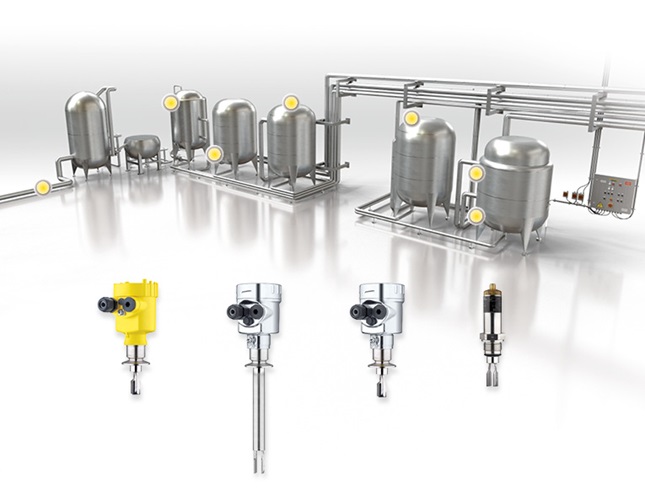
In industrial process automation, point level detection is one of the key functions for safety, efficiency and environmental protection. Whether in chemical plants, power stations, food production or shipbuilding – level switches must reliably detect when a certain limit value has been reached. They also control downstream processes like switching off a pump or closing a valve.
These level switches protect against overfilling in storage tanks, keep pumps from running dry, detect point levels in reactors, and ensure stable process conditions. At the same time, modern level switches now deliver far more than just a simple switching signal: they collect additional process data, enable diagnostic functions and support digital plant communication.
This makes them an indispensable part of modern point level instrumentation – and a key component of safe and efficient plant control.
A wide variety of physical principles are used in point level detection – from capacitive and conductive methods to microwaves, as well as radiometric and mechanical techniques. Not every measuring principle is suitable for every application. Differences exist primarily in media dependency, maintenance requirements and reliability under challenging process conditions such as foam, high viscosity or extreme temperatures.
The following overview shows how common level switch technologies differ in specific terms:
Conclusion: While capacitive, conductive or mechanical methods are often media-dependent or maintenance-intensive, the vibrating level switch impresses users with its universal application, simple integration and absolute reliability. Vibrating level switches have established themselves as the optimal solution, particularly with liquids. By combining the most important requirements – media independence, calibration-free, maintenance-free and high robustness – it is both economical and safe, making it ideal for any application of point level detection in industrial processes.

VEGA sensors, such as the VEGASWING series of vibrating level switches, are also available in hygienic versions and are therefore perfectly suited to the critical aspects of CIP and SIP processes in the food and pharmaceutical industries.
2. Dry-run protection
As dry-run protection devices, vibrating level switches protect conveying and dosing pumps as well as compressors from damage. As soon as the liquid level drops, the point level sensor detects the empty state and shuts down the system. This prevents downtime, cavitation and energy loss – a measurable contribution to energy efficiency.
3. Process monitoring under high pressures and temperatures
In tanks, pipelines, and processing systems, vibrating level switches ensure precise level detection during product changes or two-phase flows. Particularly advantageous is the insensitivity of these level switches to foaming or gas bubbles. Even with high flow rates, pulsating or aggressive media, temperatures up to +450 °C and pressures up to 160 bar – the switching signal remains stable, reliable and maintenance free.
In all applications, users benefit from reduced maintenance costs, high plant availability and easy verification of functional safety – including digital test reports.
Piezoelectric vibrating level switches, which operate according to the tuning fork principle, are especially interesting due to their versatility: A vibrating fork oscillates freely in the air and changes its frequency and amplitude upon contact with liquid. This triggers a precise switching signal, indicating that a defined level has been reached. This principle works regardless of medium density, viscosity, or foaming – a decisive advantage over capacitive or conductive methods.
The most important advantages:
The evolution from simple point level sensor to intelligent, digitally networked safety system marks a sizeable shift in process automation. Nowadays, vibrating level switches do far more than just level detection: they provide diagnostic and process data, meet safety standards such as SIL and WHG, integrate seamlessly into digital plant structures, and actively protect and optimise processes.
Whether in chemical plants, energy generation, food production, the oil and gas industry or shipbuilding – vibrating level switches are the first choice everywhere when it comes to safe, maintenance-free and smart point level measurement.
Those who rely on certified, digital level switches in planning and operation can benefit twice over: maximum process reliability and permanently low operating costs thanks to maintenance-free functionality – today, tomorrow and the day after tomorrow.
The technology of point level detection is undergoing a transformation. Point evel sensors have long been more than just binary switches – they are now sources of digital information. Features like self-diagnosis, Bluetooth communication, automatic test reports and real-time data transmission make them an integral part of highly automated industrial plants.
Besides that, modern vibrating level switches actively contribute to greater sustainability:
Modern level switches combine ecological responsibility with economic efficiency – a decisive factor for future-oriented plant design.