Slurry tank measurement simplified with non-contact radar
A slurry is a semiliquid mixture of fine particles of insoluble material usually suspended in water. Slurries are commonly used to transport solids such as minerals. As such, slurries are very common in the mining industry to transport ores and tailings over long distances. Ores are crushed and ground and then water is added to produce a slurry. Sometimes these slurries can be corrosive. In these instances, chemicals are added to prevent corrosion. When the slurry reaches its destination, the water is removed, separating the solid material.
The process of creating the slurry and then separating the requires the use of tanks, pipes, and pumps at each of the different steps. The tanks are agitated to ensure the solid components remain suspended in the liquid.
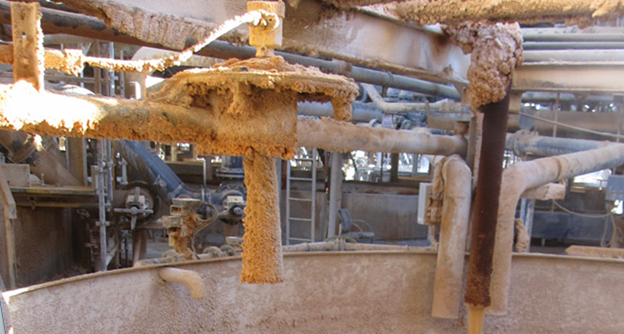
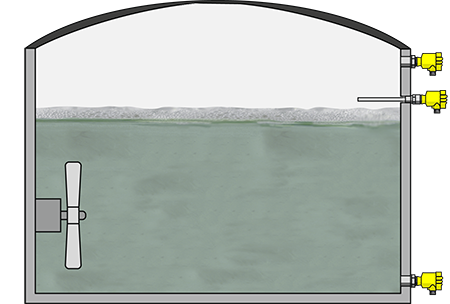
Measuring level in these tanks can be challenging. Not only is the liquid surface turbulent because of the agitation, but the agitation can also cause foam to develop. Additionally, splashing and crystallization can result in quite a bit of build-up on surfaces and structures directly above the liquid. Level devices that come in contact with the slurry are subjected to abrasion and other mechanical forces that could damage the sensor.
Non-contact radar, like the VEGAPULS 6X, is a good choice for measuring level. It is mounted above the liquid surface so that it is not subjected to the mechanical wear that contacting sensors experience. Radar is very resistant to foam and build-up. It is not affected by the rough surface of the liquid.
Overall, measuring the level of the slurry with radar is an easy measurement because the liquid carrier is water. The allows the almost any antenna system or frequency to be used. It is advisable to use a sensor that will withstand the potential build up and condensation that is likely to form on the electronics housings. VEGA offers electronics housings that are rated for this type of environment.
So, while slurries can look violent and menacing, when it comes to level measurement, radar is able to handle them with ease.
Related industries
Refining and petrochemical

Energy
Related applications
Slurry tanks in biogas plants
Point level and pressure measurement in energy production from liquid manure
Semi-liquid manure, or slurry, in biogas plants is often stored in closed, large-volume slurry tanks. Through fermentation, a valuable energy carrier is extracted from the mixture of organic waste and renewable raw materials. Level and pressure are monitored in the tank, as well as in the delivery and removal systems handling the raw materials and waste.
Reliable
Reliable operation of the fermenter through overflow protection
Cost effective
Universally applicable and modular sensors across the biogas plant, thus very cost-effective spare parts stocking
User friendly
Maintenance-free operation using build up-insensitive technologies
Acid slurry tanks
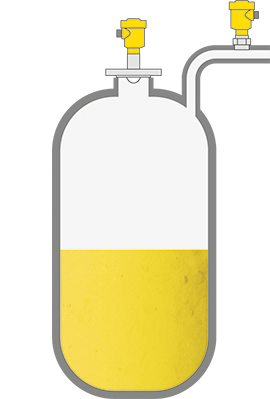
Acid level control and pressure monitoring
Acid slurries in the alkylation unit create an aggressive environment that requires robust, highly resistant level measurement instrumentation to withstand the conditions. Accurately reporting the process levels ensures that there is ample acid available for proper execution of the alkylation process.
Reliable
High reliability and accuracy for the whole lifetime
Cost effective
Non-contact measuring principles eliminate maintenance needs
User friendly
Simple mounting and setup
Compact slurry tanks in biogas plants
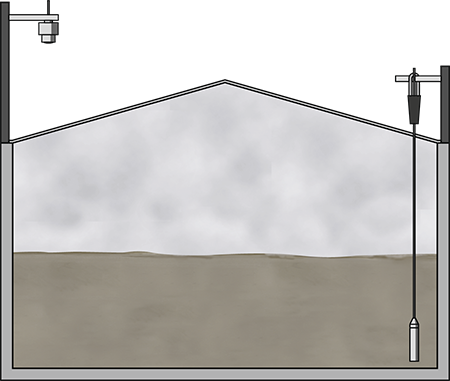
Level measurement in energy production from waste
Biogas plants convert a mixture of organic waste and renewable raw materials into valuable energy through fermentation using a largely CO2 neutral process. Optimal consumption of the resources and maintenance-free operation require the use of highly reliable measurement technology. In all production steps – from the delivery of raw materials and waste to the removal of residues – the levels must be closely and accurately monitored.
Reliable
Trouble-free operation of the fermenter with technology
Cost effective
Long service life ensured through non-contact measuring method
User friendly
Easy installation and retrofit, through external vessel mounting
Related products
Export this article
Download as PDFShare this article
Comments ({{comments.length}})
{{getCommentAuthor(comment, "Anonymous")}} {{comment.timestamp | date : "dd.MM.yyyy HH:mm" }}
{{comment.comment}}